Round on one patient
MIS 752 · Lab 13 Lite · capstone kickoff · Book Ch. 13 and Ch. 25 · no coding · patient 8410, her chart and every drug check are invented for teaching
At rounds
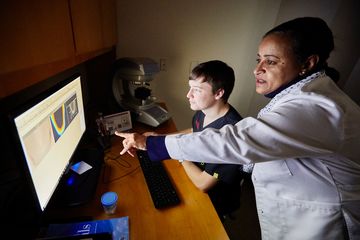 pull her chart
➜
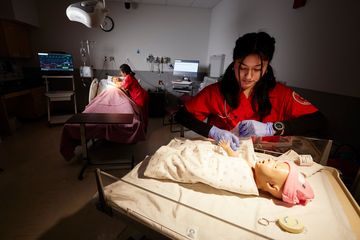 check the wristband
➜
 look it up in the chart
➜
 call the pharmacist
➜
 present it, with sources
In AI
🗂️one patient's chart
➜
🪪a guardrail runs first
➜
🔎search pulls the lines
➜
💊a tool checks the pair
➜
📎a cited answer, routed
All semester you built parts. This week they work together, on one chart. Picture a resident presenting one patient at morning rounds:
she checks the wristband first, looks it up in the chart instead of reciting, calls the pharmacist about two drugs that worry her,
and says "I don't know yet" when the chart is silent. Your assistant has to do all of that, in that order. Then the hospital asks two more
questions before it pays: did it really save time, and who signs off if it is wrong?
📖 Read Chapter 25, Regulation, Governance, and the Future (p. 602) ➜
📖 Read Chapter 13, Causal Inference (p. 280) ➜
Same book on Canvas: course files
Photos: Josh Hawkins and Becca Schwartz, UNLV Photo Services, and UNLV Special Collections & Archives. Real UNLV health-sciences spaces; patient 8410 and her chart are invented.
0 · Connect a model
Paste the free OpenRouter key from Lab 1. It stays in this browser tab only: it is never saved and never sent anywhere except OpenRouter. (Instructor's computer: leave it empty to use the local model.)
1 · One patient, one chart, five stops
Patient 8410's whole chart is on the left: sixteen lines, each with an id. In every example below, the assistant works through the five stops on the right, in order. The plain model gets none of them.
🪪
1 · Wristband check (the guardrail)Runs first. Refuses another patient's ID, an SSN, phone or email, a dosing decision, or anything not about her chart. A refusal never repeats what it caught. (Lab 10)
🔎
2 · Look it up in the chart (retrieval)Pulls the chart lines that answer the question and hands them to the model with their ids. (Labs 5 and 8)
💊
3 · Call the pharmacist (a tool)For a pair of her drugs, the model asks the interaction table. Asking for the same pair twice ends the loop with one answer-only turn. (Labs 6 and 9)
📎
4 · Show your work (the check)Every [C..] it cites must be a real line on her chart, and a value the chart lacks must be called missing. (Lab 7)
🚦
5 · Route itA major flag or a bad citation: INTERRUPT, a human reads it now. Unsure or thin: QUEUE. Clean: LOG. (Lab 9)
THE PHARMACIST'S ORDER FORM · all the model reads about the tool
💊 get_med_interactions
What it is for
Fill in
drug_a, drug_b
🔍 What this page simplifies, honestly: the chart search here is a keyword match on sixteen lines, and the wristband check is a short list of written rules. The Lab 13 notebook uses real embeddings, a reranker and a similarity score over her full Synthea chart. Patient 8410 is modeled on the synthetic patient the notebook's rule picks (84, diabetes, heart disease, ten active medications), with an invented ID.
Why does the wristband check run before the chart search and the model?
A question that should not be answered should not cost a lookup, a model call, or a log line with somebody's identifier in it. Stopping first also means the model never sees the question, so nobody can talk it into answering.
The pharmacist says "could not be checked." Is that the same as "no interaction"?
No. "Could not be checked" means the table does not cover that drug, so nobody knows yet. "No interaction" means it was checked and nothing was flagged. Blurring the two turns a gap in the data into false reassurance, so the assistant must say which one it got, and a human should look at the first.
Why does every answer cite chart lines like [C14]?
So the attending can check each claim in seconds, and so a simple automatic check can catch a citation to a line that does not exist. It is "where does it say that?" asked on every answer. A real line can still be cited for a claim it does not support, which is why a person still reads the answers.
📖 Read more in the book: What Makes an Agent: Observe, Plan, Choose Tools, Execute, Evaluate (p. 439)
📖 Read more in the book: Guardrails for Autonomous Systems (p. 452)
📖 Read more in the book: Drill: Building a Patient Q&A Agent Using RAG and Health Record Integration (p. 491)
▶ Watch: What is Agentic RAG? (IBM Technology): retrieval plus a tool, chosen by the model, inside a loop.
7 · Did it save time, really?
The CMIO's first question. A pilot let residents choose whether to use the assistant, and the ones on the lighter service used it more. Move the sliders and watch three ways of measuring the same pilot.
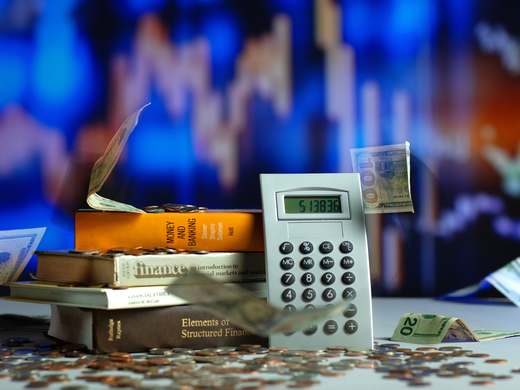
🎯 GOALSee how a naive before-and-after number can credit a tool for the patients it happened to get.
🩺 ANALOGYA new resident's patients go home a day sooner. Is she better? Look at her list: she was given the sprained ankles and the others got the sepsis. Until you compare her ankles with their ankles, you measured the assignment, not the doctor.
💡 WHYThis pilot is simulated, and that is the point: we set the true saving ourselves, so you can see which measurement finds it. A real pilot never tells you the answer.
💵 What is it worth a year?
What is the confounder in this pilot?
How complicated the patient is. It drives both who used the assistant (the easier patients, more often) and how long preparation takes (easier patients take less time anyway), so the naive comparison gives the tool credit for the easy patients.
What does "like with like" fix, and what can it never fix?
Comparing assisted and unassisted patients within the same complexity level removes the confounder you measured, so the difference left is closer to what the tool did. It cannot fix a confounder you did not measure, such as which residents were keen on new tools.
Why can this page show the true saving when a real pilot never can?
Because the pilot is simulated: we set the true saving ourselves, so we can check which measurement finds it. With real data nobody tells you the answer, which is exactly why you practice the trap where you can check.
📖 Read more in the book: Correlation Is Not Causation: Why "Red Wine" Predictions Fail Clinical Trials (p. 282)
📖 Read more in the book: Propensity Scores: The Rosenbaum and Rubin Framework (p. 287)
📖 Read more in the book: For Insurers: "Did This Treatment Actually Cause the Better Outcome?" (p. 297)
📖 Read more in the book: The Productivity Paradox: If AI Saves Time, Will Systems Just Add More Patients? (p. 480)
🌐 Try it live: a real medical study with the same trap
A 1986 study compared two kidney stone treatments. Wikipedia's article on Simpson's paradox shows its numbers in one small table. Free, no account.- Open the article and scroll to the section Kidney stone treatment.
- Compare A and B for small stones, then for large stones: which treatment wins in each group?
- Now look at the bottom row, both sizes together: which treatment looks better there?
▶ Watch: Correlation Doesn't Equal Causation: Crash Course Statistics #8 (CrashCourse, about 12 minutes).
8 · Who signs off?
The CMIO's second question. No drug reaches the formulary because one doctor liked it: a committee reviews the evidence, the risks and the monitoring plan, and someone's name goes on the decision. Fill in the paper trail for this assistant.
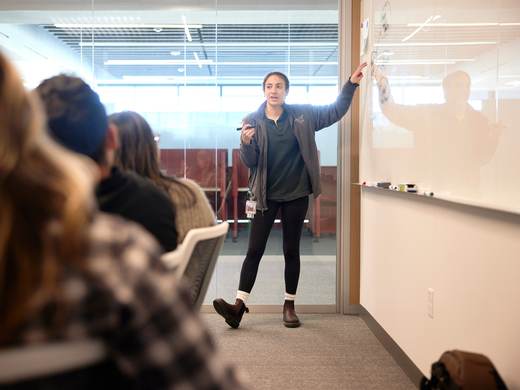
🎯 GOALDecide who approves the assistant, what it must never do, and what happens when it is wrong.
🩺 ANALOGYThe Pharmacy & Therapeutics committee decides what reaches the formulary. The package insert says what a drug is for, who it was tested on, and when never to use it. A model card is the package insert for a model.
💡 WHYThe book's point: most healthcare AI failures were not regulatory failures but governance failures. Nobody had the authority, the data or the mandate to stop the system.
PACKAGE INSERT · MODEL CARD
Round on One Patient: chart assistant
Class exercise on an invented patient. Not a clinical tool. Not validated.
What it is
A chart assistant for one patient (8410): a guardrail, a search over sixteen chart lines, one tool (a teaching table of fourteen drug pairs), a loop of at most four model calls, and a citation check.
Intended use
Answering a clinician's questions about this patient's recorded conditions and medications, with the chart line cited, during a teaching exercise.
Never use it for
- any real patient, or any patient other than the one it was built on
- choosing, changing or stopping a dose or a medication
- lab values, vital signs, allergies or notes: none were loaded, so it must say they are not in the chart
Evidence from your runs on this page
Known failure modes
- A written-rule guardrail can be fooled: a name instead of an ID, or "my neighbor in bed 4".
- It can cite a real line for a claim that line does not support.
- The interaction table covers fourteen textbook pairs, nowhere near enough for real use.
Where regulation comes in. Software that supports a clinician who can independently review the basis for what it says may fall outside FDA device oversight under the 21st Century Cures Act's clinical decision support criteria; software that drives a patient-specific decision without that transparency is closer to a medical device. Where a real product lands is a question for regulatory counsel, not for a lab. See FDA's guidance on clinical decision support software.
✍️ The sign-off
In the notebook this table is printed empty on purpose. Type a role or an invented name for each line: whose name goes on this decision?
Is every clinical AI tool regulated by the FDA as a medical device?
No. The 21st Century Cures Act (2016) excluded certain clinical decision support software from the definition of a device, using criteria FDA explains in its CDS guidance; one is that a clinician can independently review the basis for what the software says. Software that drives a patient-specific decision without that transparency, or that is meant for patients themselves, is closer to a medical device. Where a real product lands is a question for regulatory counsel.
What is a model card?
The package insert for a model: what it is for, who and what it was tested on, its known failure modes, and the uses it must never be put to. The idea comes from Mitchell and colleagues (2019) and has been adapted for healthcare by groups such as the Coalition for Health AI (book section 25.2).
The book says most healthcare AI failures were not regulatory failures. What were they?
Governance failures. Epic's sepsis model and the Optum care-management algorithm broke no regulation when they were deployed; what was missing was a group with the authority, the data and the mandate to evaluate them after go-live and stop, fix or retire them (book section 25.4).
📖 Read more in the book: The FDA SaMD (Software as a Medical Device) Framework (p. 603)
📖 Read more in the book: Drill: Creating Model Cards and Deployment Checklists for Clinical Review (p. 608)
📖 Read more in the book: Organizational AI Governance (p. 612)
📖 Read more in the book: The Liability Question: Who's Responsible When AI Fails? (p. 619)
🌐 Try it live: what has the FDA actually authorized?
The FDA publishes a list of the AI-enabled medical devices it has authorized, newest first. Free, no account.- Open the list and find the table of devices (it starts with the most recent decisions).
- Look at the Panel (Lead) column for the first twenty devices and count how many say Radiology.
- Look for anything that resembles a chart assistant like this one.
🌐 Try it live: read a real model card
Google's MedGemma is a medical model published with a full model card on Hugging Face. Reading the card is free and needs no account.- Open the card and find the section Intended use.
- Then find Limitations: what does it say the outputs are not intended for?
- Compare it with the package insert above. What does theirs say that ours does not?
▶ Watch: AI/Machine Learning: Regulation, Development, and Real-World Performance Evaluation (Duke Margolis).
9 · Your capstone on one page
This is the real skill, and your capstone starts here. Take the same five stops to a problem you care about, in healthcare or not: one record, one tool, one guardrail, an honest ROI, and a name on the sign-off. No code: plain English.
📖 Read more in the book: Workshop: Model Card, Governance Framework, and Deployment Checklist (p. 627)
📖 Read more in the book: Should You Build This? (Ch. 13, p. 298)
🎯 GOALDraft your capstone so a governance committee could say yes, no, or "not yet".
💡 WHYA demo that works is not a product. The committee asks what it reads, what it refuses, what it saves, what can go wrong, and whose name is on it.
10 · Your turn
Ask anything about patient 8410: one of her drugs, a pair of them, a lab her chart never had. Then try to get past the wristband check: another patient's ID, a dose, a phone number, the weather.
🤗 Try it live on Hugging Face
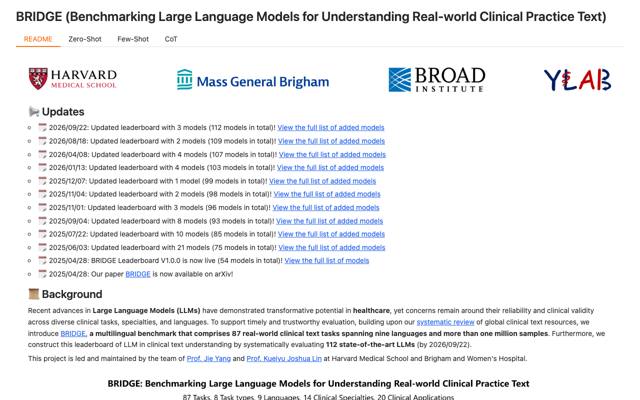
Before a hospital buys an assistant, someone has to ask which models actually handle real clinical text. Researchers from Harvard Medical School and Mass General Brigham test that in public.
Screenshot: BRIDGE Medical Leaderboard
BRIDGE: a leaderboard for real clinical text
BRIDGE ranks language models on real-world clinical practice text. Free, no account.- Open the leaderboard and look at the overall ranking.
- Find a model you used in these labs and note where it ranks.
- Look at how many tasks, languages and specialties the test covers, and which ones your capstone would need.
A model ranks near the top on BRIDGE. Is that enough to approve it for your capstone? What else would your governance checklist need?
No. A benchmark shows how a model does on someone else's tasks and data, not on your patients, your notes or your workflow. Your checklist still needs a local test on your own cases, a check across patient groups, a named person who signs off, logging, and a plan for when it is wrong. A good score is a reason to try a model, not a reason to trust it.
11 · Hand it in (Canvas, Lab 13)
1. Download your submission with the button below, then upload the file to the Lab 13 assignment on Canvas. It holds every question, your predictions, both answers, every chart line pulled and every pharmacist call, your ROI numbers, your sign-off, your capstone page and the committee's review, and everything you wrote.
2. Answer these five, a few sentences each. Each asks why:
2. Answer these five, a few sentences each. Each asks why:
- The round. Pick the example where your prediction was most wrong. What had you assumed about the plain model, and which of the five stops made the chart assistant behave differently?
- The unknown. Why is "that is not in her chart" a better answer than a plausible HbA1c? Who downstream does it protect?
- The guardrail's price. A stricter wristband check refuses more real questions; a looser one lets more through. Which mistake would you rather make at 7 a.m. rounds, and would your answer change for an app that patients use directly?
- ROI. Report your naive and like-with-like estimates against the truth, and explain why they differ. What would you need before telling a CFO the tool saves money?
- Governance. Who should sign your model card, what is the one use it must never be put to, and what would make you pause it after go-live?
Nothing you type is stored anywhere. Download your file before you close the tab.